Wednesday, November 10, 2010

Battle of Tours

Battle of Tours.png
Hello, I'm Katie and today I willing be interviewing Charles "The Hammer" Martel about the Battle of Tours.

Katie: So when was this battle?
Charles: This battle was fought by the Frankish against invading Muslims from Spain on October 25, 732.
Katie: What was the reason for this battle?
Charles: Well, a Muslim army, in a crusading search for land at the end of  Christianity, after the conquest Syria, Egypt, and North Africa, had began to invade Western Europe under the leadership of Abd-er Rahman, governer of Spain. Abd-er led an infantry of 60,000 to 400,000 soldiers across the Western Pyrenees and toward the Loire River, but we met the right outside the city of Tours.
Katie: What happened from there?
Charles: Well, I gathered my forces directly in the path of oncoming Muslim army and prepared to defend ourselves using a phalanx style of combat. The invading Muslims then rushed toward us, relying on the slashing tactics and overwhelming number of horsemen that had brought them victories in the past. However, my army and I, composed of foot soldiers armed only with swords, shields, axes, javelins, and daggers, were well trained.
Katie: What was the strength of the Muslim army?
Charles: The strength of the Muslim army was their cavalry. They were armed with large swords and lances, which along with their baggage mules, limited their mobility.
Katie: How did this battle end?
Charles: The battle ended when we captured and killed Abd-er Rahman. Then the Muslims withdrew peacefully.
Katie: What happened to the Muslims after the battle?
Charles: For the Muslims, the death of their leader caused a sharp setback and they had no choice but to retreat back across the Pyrenees, never to return again.


William the Conqueror

Hello, I'm Katie and today I will be interviewing William of Normandy, also known as William the Conqueror.

Katie: How old were you when you became the Duke of Normandy?
William: I was seven years old when I became Duke. From that day on my life was in constant danger, mostly from jealous relatives.
Katie: After you were knighted at the age of 15, what happened from there?
William: Well I got help from my liege lord, Henry I of France, to put down rebellions by my barons. Then was I was 20, I led an army to defeat my cousin, King Edward.
Katie: What happened after this?
William: Well, I raised an army and won the backing of the pope. I then sailed across the English Channel to England. At the Battle of Hastings, my army and I triumped over Harold. I then become king of England on Christmas Day in 1066.
Katie: Now that you have conquered England, what else did you do?
William: I set out to impose control over the land. I granted fiefs to the Church and to my Norman lords, or barons but I also kept a large amount of land for myself. I monitored who built castles and where. I required every vassal to swear first allegiance to him rather than to any other feudal lord.
Katie: Well that's all the time we have for today. Thank you William for being here.

Tuesday, November 9, 2010

Rome sacked/falls to Barbarians

Hello, I'm Katie and today I will be interviewing Henry Smith, a Roman citizen at the time Rome was taken over.
Katie: So in 378, when a Roman army tried to turn back the Visigoths at Adrianople, it suffered a stunning defeat. Roman power was fading. What else was going on at the time?
Henry: Well, new waves of invaders were soon hammering at Rome's borders, especially in the west. And in 410, the Visigoth general Alaric overran Italy and plundered the city of Rome.
Katie: I also heard that during this time that a Germanic people called the Vandals moved through Gaul and Spain into North Africa. What happened from there?
Henry: Gradually, Germanic groups occupied more and more of the western Roman empire. But, the worst is yet to come. Starting in 434, the Hun leader Attlia embarked on a savage campaign of conquest across much of Europe.
Katie: I heard that Christians called Attila by another name, what was this name?
Henry: Yes, Christians called him the "scourge of God" because they believed his attacks were a punishment for the sins of humankind.
Katie: As you know, the Hun invasion sent still more Germanic peoples fleeing into the lands of Roman empire. What was the last act that ended the Roman empire for good?
Henry: Finally, in 476, Ocdoacer, a Germanic leader, ousted the emperor in Rome. The Roman empire had already lost many of its territories, and Roman power in the west had ended. 

Constantine the Great

 Hello, I'm Katie and today I will be interview Constantine the Great.
Katie: So in 312, you gained the throne. As emperor what did you do?
Constantine: Well, I continued Diocletian's reforms. And in addition, I took two steps that changed the course of European history.
Katie: How did you change European history.
Constantine: First, I granted toleration to Christians. Second, I established a new capital at the centuries-old city of Byzantium, which I renamed Constantinople. With this "New Rome", Constantine made the eastern empire the center of power.
Katie: The reforms of Diocletian and Constantine had mixed results. What is your opinon on the results?
Constantine: Well, they revived teh economy, and by increasing the power of government, they helped hold the empire together for another century. Still, these reforms failed to stop the long-term decline. In the end, internal problems combined with attacks from outside to bring the empire down.

Wednesday, November 3, 2010

Julius Caesar and the Fall of the Roman Republic

 Hi, I'm Katie and today I will be interviewing Julius Caesar, a previous dictator of Rome.

Katie: So, in 58 B.C. you and your army set out to make new conquests. What happened from there?
Julius: Well, after nine years of fighting, I completed the conquest of Gaul. But, Pompey was fearful of my rising fame, so he persuaded teh senate to order me to disband my army and return to Rome.
Katie: How did you react to this order?
Julius: Well of course I defied the order. So, very secretly, I led my army across the Rubicon River into northen Italy and headed toward Rome. Once again, civil war began across the Roman world.
Katie: What happened during 44 and 48 B.C.
Julius: Well Katie, I pushed through a number of reforms intended to deal with Rome's many problems. I launched a program of public works to employ the jobless and gave public land to the poor. I also reorganized the government of the provinces and granted Roman citizienship to more people.
Katie: What do you think is your biggest accomplishment?
Julius: My biggest accomplishment would have to be the introduction of a new calendar based on the Egyptians. This calendar was used in Europe for more than 1,600 years.
Katie: Wow, that is a big accomplishment. I heard there was a big worry around this time too. What was going on?
Julius: Well, some of my enemies were worried that I planned to make myself king of Rome. So, in March of 44 B.C., as I arrived in the senate, my enemies stabbed me to death. After my death, Rome plunged into a new round of civil wars.

Alexander the Great

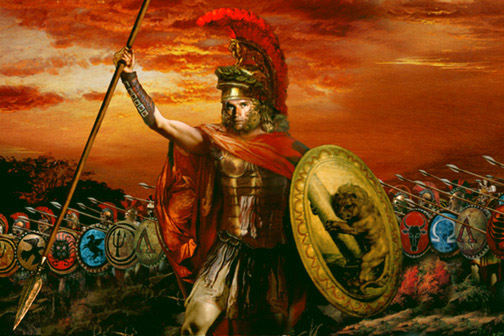
Hi, I am Katie and today I will be interviewing my good friend Alexander the Great.

Katie: So Alexander, is it true you were only 20 years old when you became king?
Alexander: Yes, my father Philip II was assassinated at his daugther's wedding, so I then became king.
Katie: What was your first accomplishment as king?
Alexander: My first accomplishment as king was when I conquer Persia. At the time, Persia was no longer the great power it had once been. The emperor Darius III was weak, and the provinces were often in rebellion against him. Still, the Persian empire stretched more than 2,000 miles from Egypt to India.
Katie: So, what happened next?
Alexander: We then won are first victory against the Persians at the Granicus River.
Katie: Did everything go well after this victory?
Alexander: Yes, actually we moved from victory to victory, marching through Asia Minor into Palestine and south to Egypt before turning east again to take Babylon in 331 B.C. But, before I could capture Darius, the Persian emperor was murdered.
Katie: So, with much of the Persian empire under your control, did things get easier?
Alexander: Yes, I guess you could say that. But, fighting for your country, your people, and your own life, never gets easy. In 326 B.C., my troops and I for the first time faced soldiers mounted on war elephants.
Katie: Wow war elephants! That sounds diffitcult! How did you handle that?
Alexander: Well, my soldiers were tired of the long campaign and refused to go farther east. So I agreed to turn back. So, after a long and diffitcult march, we reached Babylon, where I began planning a new campaign.
Katie: That must of been terrible to have to turn around and march all the way back home. What happened once you returned home?
Alexander: Well, before I could even set out again, I suddenly developed a fever and later passed away. And following my death, my empire crumbled and will never be the same as it once was  before.

Golden Age of Greece

Hello, I am Katie and today I today I will be interviewing Plato.

Katie: Ok Plato, lets start from the beginning. How do you feel about democracy?
Plato: After the execution of Socrates, I have had a lifelong distrust with democracy.
Katie: So how what was the result of this distrust?
Plato: Well, I actually fled Athens for 10 years.
Katie: Wow! Ten years that's crazy! What did you do when you returned?
Plato: I set up a school called the Academy. There, I taught and wrote about my own ideas.
Katie: I also heard that you wrote a book. Is this true?
Plato: Yes, I wrote a book called the Republic which describes my vision of and ideal state.
Katie: That's very interesting. What do you think your biggest accomplishment is?
Plato: Well, I rejected the Athenian democracy and instead I argued that the state should regulate every aspect of its citizens' lives in order to provide their best interests.Then I divided the society into three classes: workers to produce the necessities of life, soldiers to defend the state, and philosophers to rule. This elite class of leaders would be specially trained to ensure order and justice. The wisest of them, a philosopher-king, would have the ultimate authority.
Katie: Wow! That's incredible! Well, Plato thank you for allowing me to interview you.
Plato: Thank you for having me.