Wednesday, October 20, 2010

Unification Of China

Hello, my name is Gen and today I will be telling you about the unification of China. It all started in 221 B.C., during the Qin Dynasty under the rule of Shi Huandgi. Shi Huangdi became king of the Qin when he was only a boy. Well advised by officials, Zheng, as he was then known, grew to become one of the most successful warrior-kings China has ever known. After many years of war, the Qin defeated their rivals and unified China. As first emperor, Shi Huangdi set about strengthening his rule and ordering his territory. In creating a central government, Shi Huangdi undermined the feudal structure of politics that had been predominant. Likewise, he took away the hereditary claims of the nobles—going so far as to exclude them from high offices, positions he filled with common people. He standardized weights and measures and writing, and he divided China into several administrative units to help him govern better. Making it illegal to own weapons, Shi Huangdi helped secure his reign from internal threats and punished infractions quickly and harshly. To deal with external enemies, Shi Huangdi improved the earthen fortifications of earlier rulers and began work on the Great Wall of China. He also built canals, roads, and a giant palace. Yes, Shi Huandgi did have very impressive achievements, but he was a extremely harsh and cruel leader. Even though he wasn't the most kind leader, he still had some of the greatest achievements in Chinese history.


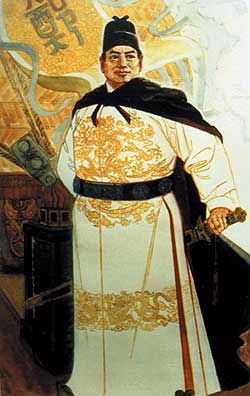
Zheng He

Hello, I am Zheng He and today I will be telling you about my role in Chinese history. Early Ming rulers sent Chinese fleets into distant waters to show glory of government. And I was the commanding Admiral on one of those ships one the first expedition in 1405. Sailng by my side were sixty-two large ships and 200 smallers ships. The goal in this expedition was to promote trade and collect tribute from lesser powers. From 1405-1433 I explored the coasts of Southeast Asia and India. But, the exploration all end in the year of my death 1435.

Tuesday, October 19, 2010

Sung Dynasty

Hello, I am Qin and I am a teacher in rural China. Today I will being telling you about the Sung Dynasty. The Sung Dynasty was a ruling dynasty in China between 960 and 1279 A.D. It was the first government in world history to issue banknotes, or paper money, and the first Chinese government to establish a permanent standing navy. This dynasty also saw the first known use of gunpowder, as well as first discernment of true north, using a compass. The Song Dynasty is divided into two distinct periods: the Northern Song and Southern Song. During the Northen Sung, the capital was in the northern city of Bianjing and the dynasty controlled most of inner China. The Southern Sung  refers to the period after the Song lost control of northern China to the Jin Dynasty. First, I will start by telling you about the northern Sung. The Northern Sung was the first, most advanced, and longest period of the Sung history. The increase in education carried the literature advancements from the Tang Dynasty into the Sung period. With this rise in culture came a new religion, called Neo-Confucianism. This religion was thought of by a scholar named Chu Hsi. He combined three religions from the Tang period and put them into the Neo-Confucianism that became the orthodox state doctrine. Governmental positions were based on exams over the teachings of Confucius. This was much better than the aristocrats ruling due to family linage rather than knowledge. The economy rose by putting these newly educated people into positions of authority. The only bad part of the period was the weak military directly under the emperor's control. He feared that power hungry generals might want to rebel. When small barbarian tribes or nations would attack then the Sung would try to sign treaties with them. After Wang’s death most of his work was repealed, until after the Mongols took over. The Juchens, who had made an alliance with the Sung, rebelled and forced the Sung to flee south. This was the beginning of the Southern Period. Wang’s death came at the end of the Northern Sung period. When the Southern period started, reformers and antireformers fought for power making this government unstable for a short time. During this period there were no trade routes by land that could be used due to hostile patrols by opposing forces. The creation of a ship called a junk was what people used for their trading ventures. Gunpowder was created and the pottery industry advanced with the creation of porcelain with a celadon glaze. With these new creations came dramatic increases in agriculture and production based economies. The Sung Dynasty ended when a group of Mongols under the command of Kublai Khan overthrew the Sung. The Sung did not have much of a military to defend themselves against the Mongol force that was sweeping across the Asia.

Tang Dynasty

Hello, I am Liu and I am a merchant in Northen Vietnam. I will be telling you about the Tang Dynasty. The Tang Dynasty, 618-907 A.D., was a dynasty that was characterized by strength and brillance. The Tang Dynasty was vast, with its control raging from Korea, southern Mancuria, and northern Vietnam. It was founded by the Li family who, seized power during the decline and collaspe of the Sui Empire. The dynasty was interrupted briefly by the Second Zhou Dynasty  when Empress Wu Zetian seized the throne,  becoming the first and only Chinese empress regnant, ruling in her own right. The Tang Dynasty is considered the high point in Chinese civilization. Its territory, acquired through the military campaigns of its early rulers, was greater than that of the Han period, and it rivalled that of the later Yuan Dynasty and Qing Dynasty. With its large population base, the dynasty was able to raise professional and conscripted armies of hundreds of thousands of troops to contend with nomadic powers in dominating Inner Asia and the trade routes along the silk road. The Tang Dynasty was largely a period of progress and stability, except during the An Shi Rebellion  and the decline of central authority in the latter half of the dynasty. The Tang Dynasty maintained a civil service system by drafting officials through standardized examinations and recommedations to the office. Chinese culture flourished and further matured during the Tang era.

Mongols take China

Hello, I am Zhen and today I will being telling you about the Mongols taking over China. The Mongols first started off as a nomadic group living in rural areas of Central Asia. In the early 1200s Mongol chieftain took the name of Genghis Kahn, or the "universal ruler." Genghis Kahn, originally named Temujin, was known for being very ambitious and courageous. Genghis's life was rough from the beginning. At the young age of nine, his father was poisned by a rival Mongol clan. And by the age of fifteen, he was a taken prisoner. After being let free, he was determined to get his revenge. Once the Mongols took over China they inforced very strict military discipline and demanded absolute loyalty. They quickly developed a highly skilled army and had the best horseman in the world. Genghis accomplished many extraordinary things during his rule. But sadly, he died during the conquest. After Genghis, Mongols were not oppressive leaders. He very much respected artisans, artists, and scholars. He even listened to the ideas of Confucians, Buddhists, Christians, Muslims, Jews, and Zoroastrians. Between 1200s-1300s the Mongols took control over the Silk Road, and not longer after trade began to flourish. Even the cultural exchanges increased in food, inventions, tools, and ideas spread along the protected trade routes. It took seventy more years for Kublai Kahn to conquer southern China. In the year 1279, the Song Empire was conquered. Not long after the Song Empire was conquered, Kublai Kahn declared that only Mongols could serve in the military. He also reserved the highest government jobs for Mongols only. In 1279 A.D. the Yuan Dynasty begins. A mix up of Chinese and foreign customs arouse in China. Once the Yuan Dynasty started, Kublai got right down to business. He turned Beijing into a walled city, extended the Grand Canal to his new capital, and made the shipment of rice and other foods easier. In 1294 Kublai Kahn died, which led to the decline of the Yuan Dynasty.

Han Dynasty

Han Dynasty HorseHello, I am Liu Bang, the prince of Han. The Han empire began in 206 B.C. when I defeated the Qin army in the valley of Wei. This war all started because the people were dissatisfied with the tryanny of the Qin Leaders and their Legalist form of government. The Han continued to rule in the traditaion of the Qin, and only gradually incorporated Confusican ideals into their Legalist form of government. Under this new form of Legalism and Confucianism, rewards and punishments were still used for common people. However, the administrators were judged based on Confucian princples with the justification for these different sets of standards as they were educated. Just like the Qin Dynasty before us, our main goal is the unification of China. This goal led to the downfall of imperial nobility. This process was finally completed during the reign of Wu Ti's, from 141-87 B.C. His reign was a period of great military expansion. The Han dynasty is actually two separate dynasties. It is considered one dynasty by the Chinese because the second dynasty was founded by a member of the former Han dynasty who declared he had restored the Han Dynasty. The second Han Dynasty had much success with their foreign policy. In 73 A.D. the Chinese began a campaign in Turkestan. Turkestan was quickly conquered which would have ensured a trading monopoly, however, the emperor Ming Ti died and Chang Ti became emperor. He favored an isolationist policy so that much of what was gained in Turkestan was now lost. Pan Ch'ao, the deputy commander who had led the invasion, stayed in Turkestan to try and hold onto what had been won, and eventually in 89 A.D. a new emperor came to power with a renewed interest in holding Turkestan. Despite the military success, economic and political struggles arose within China. Internal struggles for power taxed the peasants, until in 184 A.D. when another peasant uprising occurred. This movement was begun by the Yellow Turbans. This uprising served to unite the factions who had previously been fighting one another because they needed to unite to defeat the Yellow Turbans. Despite conquering them, China did not return to a united state. Rather, three kingdoms emerged and the Han Dynasty came to an end.

Buddhism comes to China

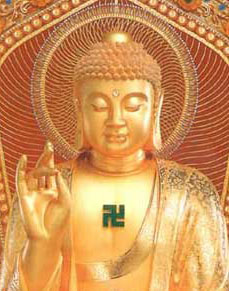
Hi, I am a good friend of Siddhartha Gautama, also known as the Buddha. Siddhartha was a prince of the Sakya Tribe of Nepal in 566 B.C. His father never wanted Buddha to leave the palace, he wanted him to become one of the best rulers anyone has ever known. But Buddha knew being a ruler wasn't his true calling in life. He knew there was something better beyond the palace walls. So, at the age of twenty-nine, Buddha left the palace and the comfort of his home, to seek the meaning of the pain and suffering he saw around him. He trained for six years with yoga masters and spiritual teachers. He tried many forms of meditaion and yoga, including severe regimes of fasting during which he nearly died. Finally, Siddhartha found enlightenment. Siddhartha, now known as Buddha, taught his followers the Four Noble Truths and the Eightfold Path to help others achieve enlightenment as he had. By the year 300 B.C., Buddhism was a major religion in India. Buddhism was spread along the Silk Road and other trade routes and had reached China in the year 67 CE. Today, Buddhism is one of the main religions in China. Buddhism is actually one of the most practiced religions in the world.